
The debate between butter and margarine has shifted over many decades as nutrition science has advanced.
Early dietary advice supported margarine for heart health, mainly due to its lower saturated fat content. Later concerns about trans fats changed that view and led to renewed scrutiny of margarine products.
Current guidance focuses more on fat type rather than choosing one spread over the other. Saturated fats and unsaturated fats play a central role in health outcomes, making composition more important than the product name.
That is why it is important to talk about this topic in greater detail.
Nutritional Comparison
| Category | Butter | Margarine |
|---|---|---|
| Total Fat | About 80% fat | About 80% fat |
| Main Fat Type | 50-65% saturated fat | Mostly unsaturated fats (polyunsaturated and monounsaturated) |
| Effect on Cholesterol | May raise LDL cholesterol due to high saturated fat | Can help lower LDL cholesterol when replacing saturated fats |
| Fat Characteristics | High in saturated fat, low in unsaturated fat, solid at room temperature | Rich in unsaturated fats, soft types have healthier fat profiles |
| Cholesterol Content | Contains dietary cholesterol | Naturally cholesterol-free |
| Calories | Similar calorie content per serving | Similar calories, lighter versions may have fewer due to added water |
| Vitamins | Naturally contains vitamins A, D, E, K | Often fortified with vitamins A and D |
| Additives | Minimal processing, few additives | May include emulsifiers, preservatives, and colorings depending on product |
Clear differences between butter and margarine start with their composition. Both are high-fat spreads, yet the type of fat and added nutrients create meaningful distinctions that influence health outcomes.
Fat Content
Both butter and margarine contain about 80% percent fat, but their fatty acid profiles differ significantly. Fat type plays a central role in how each product affects cholesterol levels and overall heart health.
Butter contains a large proportion of saturated fat, typically between 50% and 65%. High intake of saturated fat is associated with increased LDL cholesterol, which is linked to cardiovascular risk.
- High saturated fat content that can elevate LDL cholesterol
- Limited amounts of beneficial unsaturated fats
- Consistency that remains solid at room temperature due to fat structure
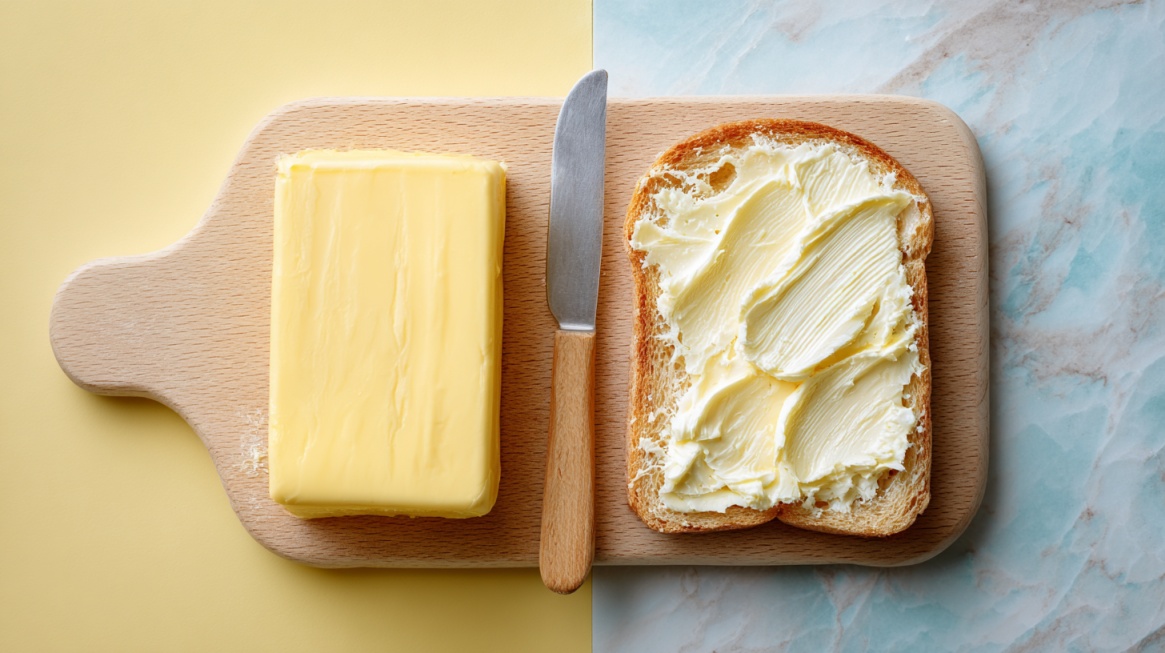
Margarine is generally made using plant oils that are rich in unsaturated fats. These fats can help reduce LDL cholesterol and support heart health when used in place of saturated fats.
- Soft or spreadable varieties contain more unsaturated fats
- Hard stick margarines may include higher levels of saturated fat
- Polyunsaturated and monounsaturated fats contribute to improved lipid profiles
Cholesterol and Calories
Cholesterol content represents another key difference. Butter contains dietary cholesterol, while margarine does not.
Butter includes cholesterol as a natural component of animal fat. Current research suggests that saturated fat has a greater effect on blood cholesterol levels than dietary cholesterol itself. Margarine, made with plant-based oils, is naturally free of cholesterol.
Calorie content remains similar between both products, since fat provides the same amount of energy regardless of source.
- Standard butter and margarine provide similar calories per serving
- Reduced-fat margarines may contain fewer calories due to added water
- Portion size plays a larger role in calorie intake than product type
View this post on Instagram
Vitamins and Additives
Nutrient content differs due to natural composition and fortification practices. Butter contains naturally occurring vitamins, while margarine is often enhanced to achieve a comparable profile.
Butter provides fat-soluble vitamins that occur naturally in dairy fat. These include vitamins A, D, E, and K, which support vision, immune function, and bone health.
Margarine products are often fortified to match or exceed butter’s vitamin content. At the same time, processing introduces additional ingredients that vary by brand.
What are the Health Impacts?
Health effects depend largely on fat composition rather than the product name. Research has shifted focus toward how different fats influence cholesterol levels and long-term disease risk.
@foodmeetsscience 🧈🧠 Butter or margarine, which one is actually better for you The answer is not as simple as good vs bad. Butter is a natural product made from cream. It contains saturated fat, but also fat soluble vitamins and compounds that contribute to flavour and satiety. Margarine was created as an alternative. Early versions contained trans fats, which are clearly harmful. Modern margarines are different. Many are made with unsaturated plant oils and no trans fats, but they are still highly processed. From a science perspective, health depends on type, quality and quantity. Butter in moderation can fit into a balanced diet. Margarine can be a better option if it is low in saturated fat and free from trans fats. It is not about choosing sides. It is about understanding fats and using them intentionally. #foodscience #butter #margarine #fats #healthyfood ♬ оригінальний звук – Classical Music
Heart Health
High intake of saturated fat is linked to elevated LDL cholesterol, a major risk factor for heart disease. Replacing saturated fats with unsaturated fats can lower that risk and improve overall cardiovascular health.
Health recommendations often focus on practical dietary changes.
- Choosing spreads made with unsaturated fats instead of butter
- Reducing total intake of saturated fat
- Maintaining balanced eating patterns that support heart health
Trans Fat Issue
Trans fats played a major role in shaping opinions about margarine. Earlier formulations relied on partially hydrogenated oils, which created harmful trans fats.
- Increase in LDL cholesterol
- Reduction in HDL cholesterol
- Strong link to higher risk of heart disease
Modern production methods have addressed these concerns. Most margarines available today contain little to no trans fat due to regulatory changes and reformulation efforts.
Natural vs Processed Debate
Public perception often favors foods labeled as natural. Butter is frequently seen as a simpler option, while margarine is often linked to industrial production.
Such views influence consumer choices, even when nutritional differences are more important than processing methods.
Butter is made by churning cream until the fat separates, forming a solid product. Production involves relatively few steps and minimal added ingredients.
- Simple ingredient list, often just cream and sometimes salt
- Limited processing compared to many packaged foods
- Familiar production method used for generations
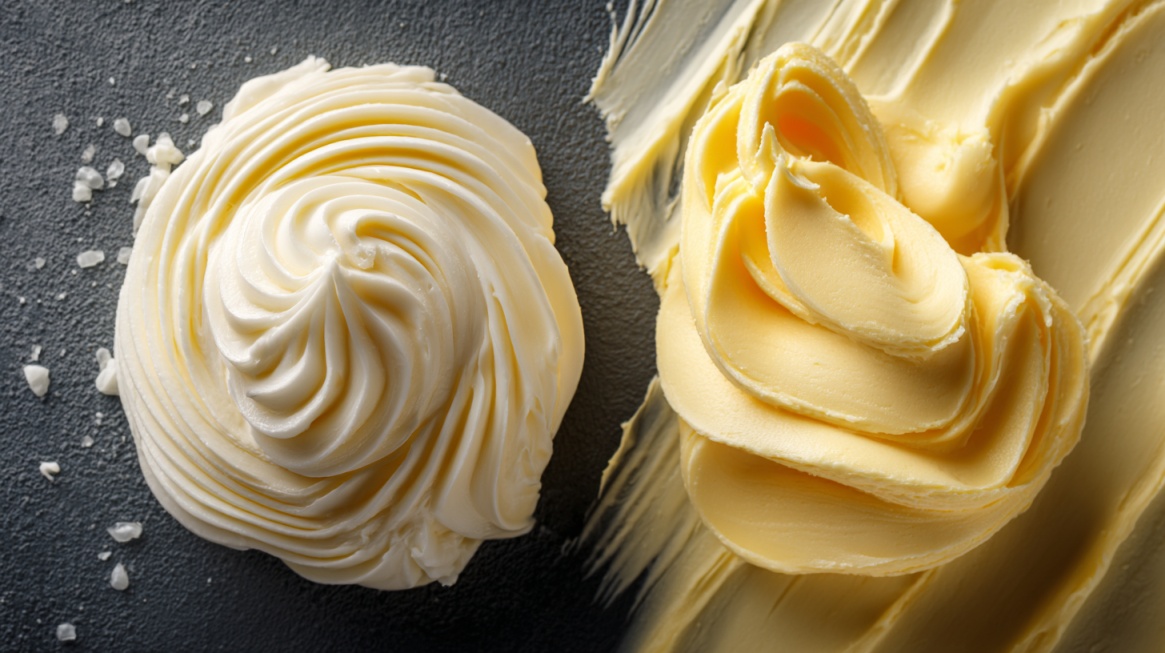
Margarine is created using plant oils that go through several processing stages to achieve a spreadable texture. Production methods have changed over time, especially with the removal of trans fats.
- Blending vegetable oils with water to form an emulsion
- Use of emulsifiers to maintain consistency
- Controlled processing techniques to adjust texture and stability
Perception of natural versus processed does not directly determine health effects. Nutritional value depends more on the types of fats present and how they influence cholesterol levels.
A product with healthier fat composition can provide better outcomes even if it involves more processing steps.
Which Is Healthier?
| Butter | Margarine | |
|---|---|---|
| Pros | Contains natural fat-soluble vitamins (A, D, E, K) | Usually lower in saturated fat |
| Minimal processing | Contains unsaturated fats that support heart health | |
| Fewer additives | Often fortified with vitamins | |
| Cons | High in saturated fat | More processed product |
| May raise LDL cholesterol | Nutritional value varies by product | |
| Excess intake may increase heart disease risk | Hard varieties may contain more saturated fat |
Most health organizations suggest that soft margarines rich in unsaturated fats offer a healthier option compared to butter, especially regarding heart health.
Not all margarines provide the same benefits. Products low in saturated fat and free of trans fats are better choices.
Butter can still fit into a balanced diet when used occasionally and in small amounts.
Overall diet quality has a greater effect on health than any single food choice.
Also Read: What is the healthiest peanut butter you can find and how to find it. Stay healthy and stay full!

Hi there, my name is Kelly Barlow and kellytoeat.com is my blog. Here, I write about various recipes I want to reccommend to readers.
I try to find the best possible recipes that can attract the attention of readers, and at the same time, I strive to write it in the most engaging manner possible.
When I was younger, I wanted to become a chef. Sadly, it wasn’t meant to be, but at the very least, I write about it.